All 6 Core Products
A unified Business Operating System designed for companies that refuse to outgrow their software.

A unified Business Operating System designed for companies that refuse to outgrow their software.
Autonomous stock control ledger with RFID integration and real-time ledger updates.
We know exactly what every product costs to make, and we provide real-time insights into production staging and shop floor analytics.
Automated journal postings from sales, inventory dispatches, and 1-click GST filing.
Uncapped capabilities and unlimited users with clear licensing tiers.
Guaranteed zero-downtime database import of legacy accounting and ledger details.
Read-only enterprise accounting access designed for secure compliance auditing.
Discover how dynamic multi-warehouse routing technology optimizes SME fulfillment operations, reduces overhead costs, and accelerates order delivery speeds.
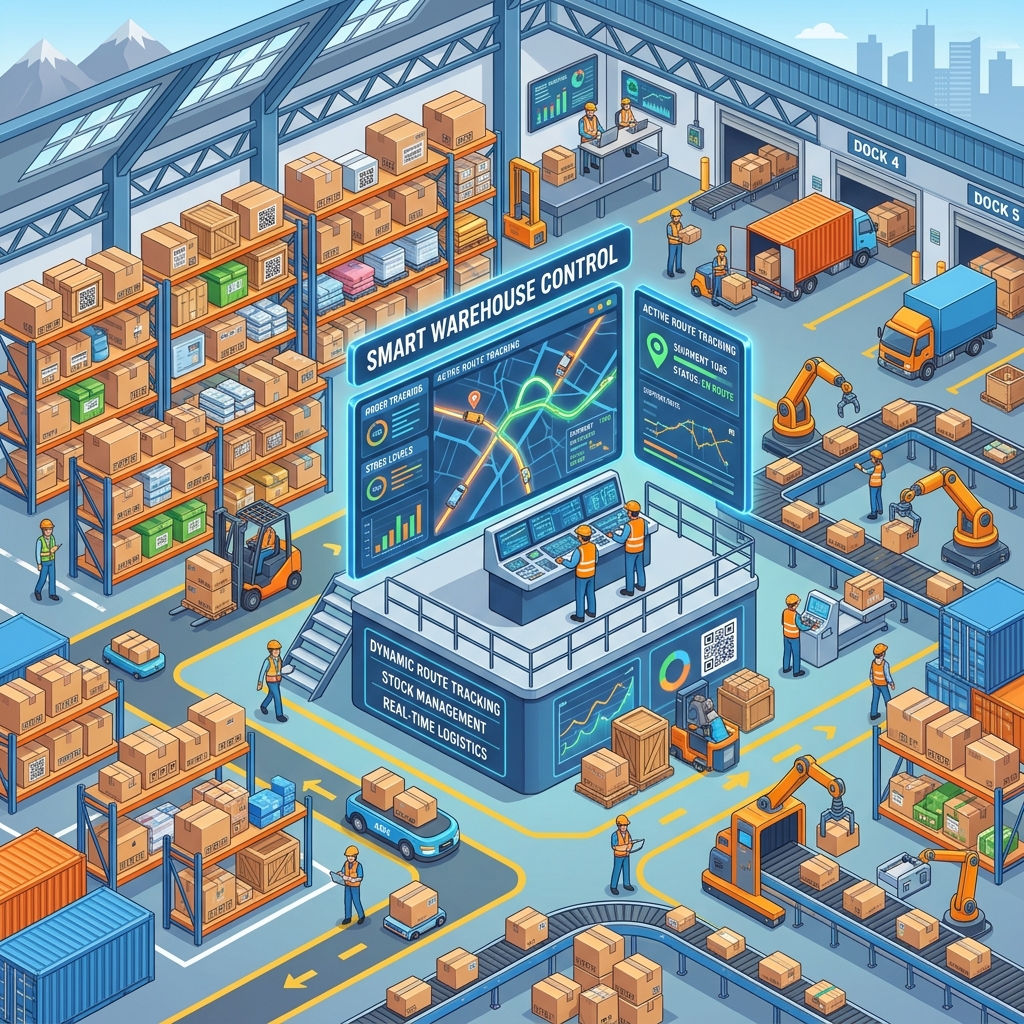
As growing enterprises scale their operations, centralizing fulfillment from a single distribution hub quickly becomes an operational liability. To maintain competitive shipping speeds and control freight overhead, businesses must adopt multi-location storage models—leveraging regional fulfillment centers, micro-warehouses, or retail storefronts as active shipping nodes. However, coordinating optimal order assignments across multiple geographic nodes manually introduces severe complexity and error rates.
Dynamic multi-warehouse routing technology provides the algorithmic logic required to orchestrate this complexity. When an order is placed, a modern Order Management System (OMS) evaluates a matrix of variables in real time: geographic proximity to the end customer, precise inventory availability across all sites, carrier rate sheets, and the current operational picking queues at each facility.
By programmatically routing orders to the optimal fulfillment node, businesses can drastically reduce split shipments—scenarios where a single order requires multiple packages from different locations, which essentially doubles shipping costs and degrades the customer experience. Intelligent routing also balances the fulfillment load across the network, preventing bottlenecks where one facility is overwhelmed while another holds idle stock.
For retail organizations with physical storefronts, dynamic routing serves as the bridge between digital commerce and physical operations. Shop floors are transformed into localized fulfillment centers (Ship-from-Store), enabling rapid, cost-effective last-mile delivery. Converting physical inventory into active digital nodes maximizes asset utilization across the entire network.
Transitioning from static allocation to dynamic routing is a fundamental requirement for scaling modern retail operations. OrynBiz WMS & Inventory Core provides advanced fulfillment routing logic natively, allowing supply chain teams to elevate delivery speeds and lower operational overheads without relying on fragmented third-party integrations.
The OrynBiz editorial team provides deep-dives on ERP database design, supply chain automation, and enterprise operations for growing businesses.
How zone-based wave picking, FIFO/FEFO expiration enforcement, and sub-100ms wireless barcode verification prevent warehouse mis-picks in high-SKU distribution centers.
Managing multi-stage Bills of Materials, scrap yield variance tracking, and GST Annexure-II job-work challans without disconnected factory spreadsheets.
How enterprise ERP architectures generate instant IRN QR codes, automate NIC portal failover queueing, and eliminate dispatch bottlenecks during high-volume billing.
Eliminate siloed tools and spreadsheets. Experience the speed, continuous GL sync, and autonomous intelligence of OrynBiz.