All 6 Core Products
A unified Business Operating System designed for companies that refuse to outgrow their software.

A unified Business Operating System designed for companies that refuse to outgrow their software.
Autonomous stock control ledger with RFID integration and real-time ledger updates.
We know exactly what every product costs to make, and we provide real-time insights into production staging and shop floor analytics.
Automated journal postings from sales, inventory dispatches, and 1-click GST filing.
Uncapped capabilities and unlimited users with clear licensing tiers.
Guaranteed zero-downtime database import of legacy accounting and ledger details.
Read-only enterprise accounting access designed for secure compliance auditing.
Discover how modern cloud accounting platforms shift businesses from retrospective month-end closing cycles to continuous, real-time financial tracking and reporting.
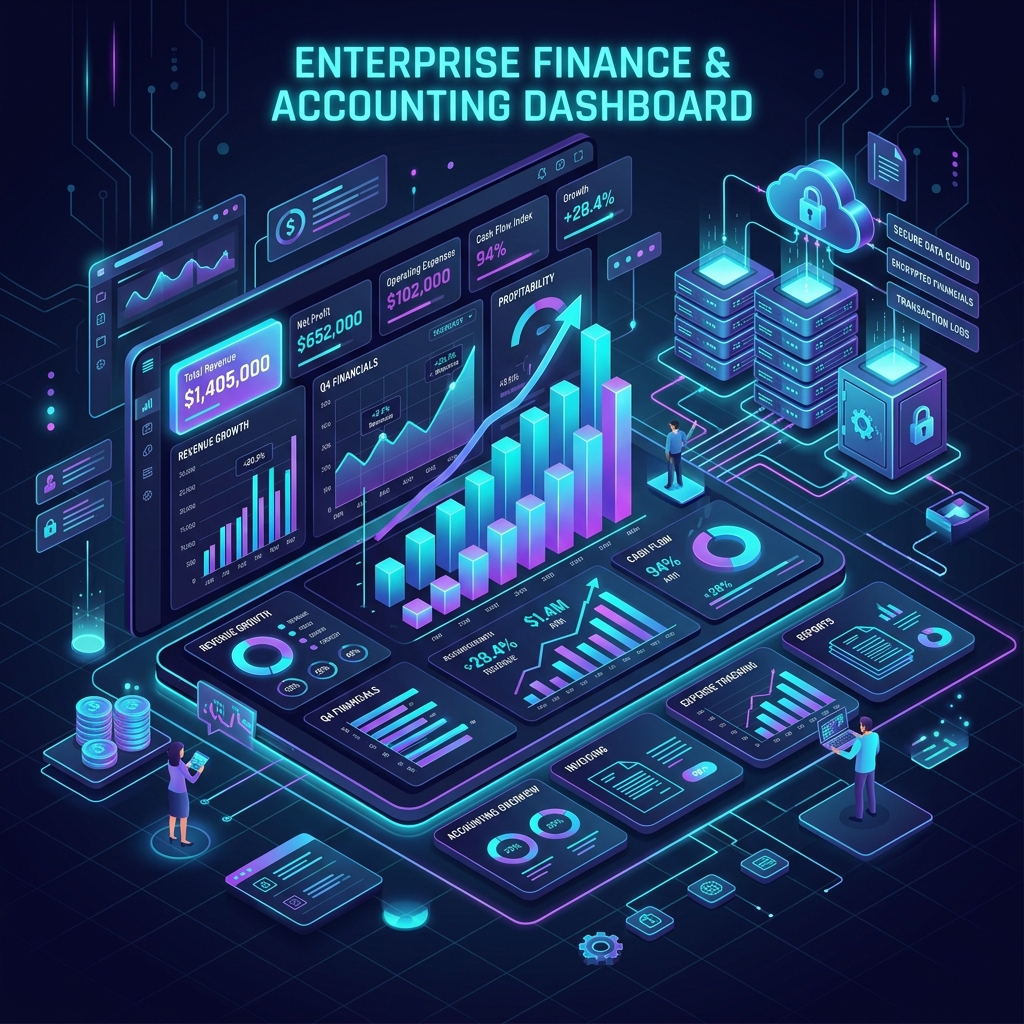
Historically, corporate accounting has functioned as a retrospective discipline. Finance departments routinely dedicate the first weeks of every month to closing the books on the previous cycle. While this batch-processing approach yields structured, auditable ledgers, it forces executive leadership to make strategic decisions based entirely on historical data. Operating on delayed financial insight introduces significant risk.
The transition to real-time financials represents a fundamental shift in capital management. Modern cloud-native accounting architectures—embedded within ERP systems—integrate directly with POS networks, warehouse inventory systems, procurement pipelines, and banking APIs to record transactions instantaneously. This continuous data flow ensures that balance sheets, P&L statements, and cash flow projections are dynamically updated, providing an immediate, accurate assessment of organizational health.
Eliminating the month-end reporting lag allows organizations to detect cost overruns, monitor departmental budget consumption, and capitalize on early-payment vendor discounts in real time. Instead of discovering a project deficit weeks after the fact, management teams can intervene within hours. For treasury management, this immediacy translates to precise capital allocation and optimized liquidity.
In a continuous accounting environment, security and regulatory compliance are significantly strengthened. Automated auditing algorithms run background integrity checks against every transaction, instantly isolating anomalies, identifying duplicate invoices, and flagging unauthorized expenditures. This systemic monitoring neutralizes fraud risks and drastically accelerates year-end external audits, as transaction verification occurs continuously rather than as a delayed batch process.
Real-time enterprise accounting provides the necessary data infrastructure for autonomous financial planning and analysis. OrynBiz ERP's unified financial modules dissolve the structural barriers between field operations and the accounting ledger, empowering finance leaders with continuous visibility and predictive agility.
The OrynBiz editorial team provides deep-dives on ERP database design, supply chain automation, and enterprise operations for growing businesses.
How zone-based wave picking, FIFO/FEFO expiration enforcement, and sub-100ms wireless barcode verification prevent warehouse mis-picks in high-SKU distribution centers.
Managing multi-stage Bills of Materials, scrap yield variance tracking, and GST Annexure-II job-work challans without disconnected factory spreadsheets.
How enterprise ERP architectures generate instant IRN QR codes, automate NIC portal failover queueing, and eliminate dispatch bottlenecks during high-volume billing.
Eliminate siloed tools and spreadsheets. Experience the speed, continuous GL sync, and autonomous intelligence of OrynBiz.